
We are automata
The realisation that changed my perception of life

Should I speak truthfully, or should I lie for the sake of your comfort?
Truely, what would you rather?
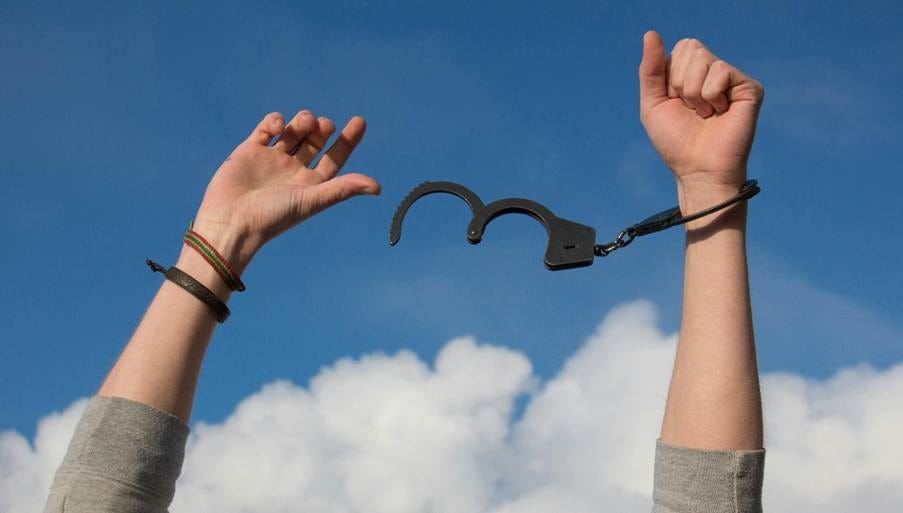
By the end of this article I hope you will understand that our lives are like random movies we are assigned before we are born. Each of us given a brain we didn’t choose, a family we didn’t choose, looks we didn’t choose, a body we didn’t choose, a nationality we didn’t choose, and so on. The most important point here, at least the most relevant to my argument, is that we didn’t choose our brains. And so, we each watch a different movie that is ‘played’ by the underlying programming of our brain. But this movie is different to most movies you are familiar with. For this movie is so real that you THINK you can control what happens, but you can’t. You will be so convinced that you can control the outcomes in your particular movie that to insinuate otherwise would be ludicrous. Well, I am here to convince you that it is in fact not ludicrous.
The central question at the heart of today’s article is a question I have asked myself many times now. One I emphatically have my answer for, and yet simultaneously feel a sense of moral obligation around whether to spread the word of my newfound understanding.
Okay enough with the suspense, what am I even talking about?
None other than:
whether we had any ability to have done differently to what we did in the past or whether we were always fated to make the decisions we made
For the uninitiated, this is an age old question in philosophy which is call the ‘free will’ debate. By free will here, I mean in the most absolute sense – could I have feasibily done differently?
Now, let’s hold this idea for a moment – surely we had choice right? I make many choices a day. It seems obvious. Right?
Turns out, all is not exactly as it seems, and I will get to this and the ramifications of it in this article. But first, let’s do what I always do when confronted with something I don’t have an answer for…good old ChatGPT.
Prompt:
No BS, and give me a one line answer, did we have any ability to have done different to what we did in the past?Answer:
No – given your exact brain state, experiences, and environment in each moment, you could not have acted different than you did.Take a minute to digest this properly.
Has the gravity of this realisation dawned on you yet?
That everything you once thought to be true (i.e. that you are the orchestrator of all your decisions and actions) is in fact likely all one big lie? That everything is just a giant chain of cause and effect all the way back to the Big Bang?
Well turns out this is the most likely case, and one I wholeheartedly believe in. Even if we account for weird quantum randomness that exists at the subatomic scale, we still ultimately have no control over our decisions – we were always going to do whatever we did. Rather, our decisions and actions form an interconnected chain through time, one impacting the next, unimpeded by any external force other than the laws of physics alone.
And this is the sentiment of many physicists, mathematicians and great minds alike, including none other than Einstein and Tesla themselves. To quote Tesla, who in my opinion is the greatest mind to have ever graced the Earth (and whose quote formed the inspiration of my article’s title):
“We are automata entirely controlled by the forces of the medium being tossed about like corks on the surface of the water, but mistaking the resultant of the impulses from the outside for free will”
Nicola Tesla
A topic that causes a lot of discomfort
It feels very un-human doesn’t it?
The idea that we are just a bunch of swarming particles with no control over what we think, say or do. It goes against every work of poetry every written, every unique expression of art, the sense of egoism - all opposing the core of what it means to be a sentient, feeling and loving person. Seemingly stripping away the very essence of what makes us, us.
Yet, it is very likely to be true. In fact, given known physics, it appears to be the most likely explanation for life in general for the sole reason that having true agency requires something beyond known physics to be involved.
Mull on that for a second – what you have perceived your whole life as being trillions of choices YOU have made along the way, is nothing more than the pre-ordained dance of particles of which you are constructed.
Your feeling of agency in this world is an ‘emergent property’ that has arisen from the complex interplay of underlying processes which by the time you have made a ‘conscious’ choice, these processes have already made your decision for you. In other words, your conscious experience can be thought of as a ‘shadow’ – it results from what came before it but can’t in any way influence its priors. The philosophical jargon used for this is that ‘downward causation’ doesn’t exist – i.e. anything that emerges cannot somehow magically rewrite the constituents from which it was created it in the first place.
When I realised this, it is no exaggeration to say that it changed my world forever. It fundamentally changed my perception of reality; the way I see the world; the way I see luck, my view on morals and meritocracy, and my perspective of possessing an ego at all. I felt like I had been living a lie up until this point.
I want other people to feel this awakening, to see what I see – the crazy notion that we are all algorithmically produced creatures who have cute egos strapped to us like we are so deserving of all our achievements, only to have this fundamentally crushed by the realisation that the known laws of physics don’t allow for it. Unless of course every particle is choosing where it goes, it is a mathematical impossibility that we ultimately choose our actions.
People get a little tripped up on what is meant by all this, thinking that it means everything is already pre-written. However, I like to think of it a little differently and I have an analogy too – to me it is kind of like writing a book. Imagine a book that has been half written. We don’t yet know the final text that will adorn every page of the book. However, in a world of no free will (like ours) the book will only ever be written in one way. It is equivalent to fate, but importantly, the fate is not known in advance.
Anyway, I’m probably getting a little too abstract. The point I’m trying to make here is that if indeed our world has no free will, then it follows that fate exists. Pretty cool if you ask me. You were always fated to meet your first love. You were fated to make all the friends you have made. And you were fated to be reading this article right now, and feeling the particular emotions you are feeling while reading it.
Explaining the math
We even have a proof to help back up the argument. It is called “The Free Will Theorem” by John Conway and Stephen Kochen in 2006, which states that for pure free will to exist (often called metaphysical free will by philosophers) every particle must have their own decision-making properties. In other words, they must be choosing where they move at a fundamental level. This seems very unlikely given what we know about particle behaviour.
The way I like to think about, is to consider a high-level equation that dictates the firing of each individual neuron. Let’s assume it looks something like below:
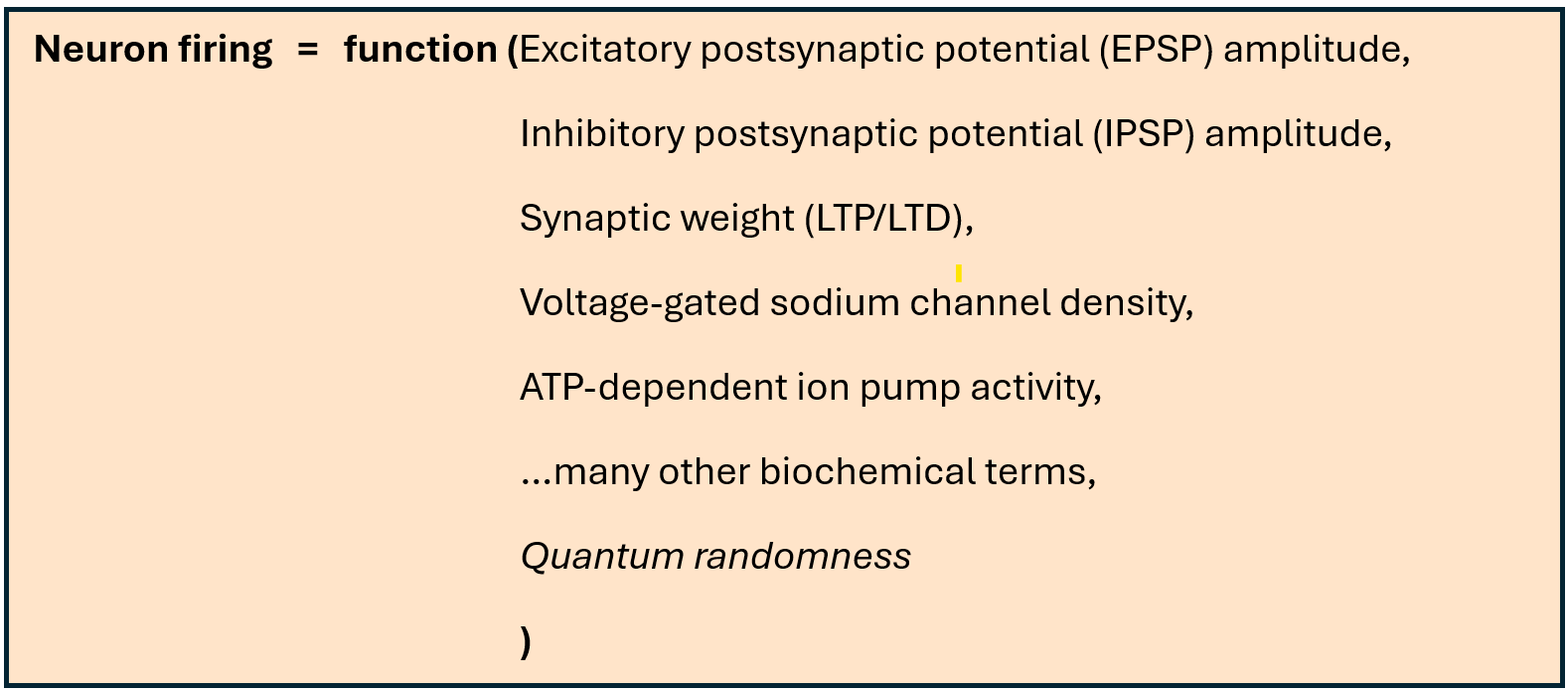
In this equation, each neuron’s firing is simply a function of different biochemical interactions, as well as including a variable for quantum randomness too. There is no additional variable that allows for ‘choice’ beyond the laws of physics doing their thing.
What I’m trying to say is that the brain is essentially 86 billion neurons, each following equations much like the one above. And when I consider those equations, I struggle to see how any choice we make could arise from anything beyond these chemical interactions — even if you include quantum randomness, which lies outside our control as well.
Nah, I still don’t agree!
It is extremely uncomfortable for people to learn this, and my gut says about 99% of people will instantly reject it.
“Nup, bullshit. I chose to drive into work instead of cycling today. ‘I’ made the choice”.
This is how most people react, and admittedly, so did I when my friend first posed the question to me.
“Of course I choose what I am doing”, I said, and progressed to make weird sounds and shake my hands in the air.
“You can’t tell me that was scripted?”.
As famous modern day physicist Sabine Hossenfelder explains:
“I believe the problem is that many of us have grown up thinking our brain works in a particular way. Then we learn that this isn’t compatible with science, and we have a hard time readjusting how we think about ourselves”
Sabine Hossenfelder
The more I thought about it, the more it became clear to me that our experience of reality is so very far from what it actually is.
Akin to the debate of religion, the debate of whether there is or isn’t free will becomes emotionally charged. I have realised this online, where tempers flare, all while half the people don’t really know what they’re arguing at all. As emotional beings, when we feel the threat of all our achievements being stripped from us, we innately fight back – I earned everything! It was all due to me having greater willpower than others, they will say. In one sense, this is correct, but in another it is not – yes, you may have ‘willed’ your life to be, but you didn’t ‘will your willpower’. It’s a subtle but important difference.
As I have gotten older I have come to realise that being more intelligent does not necessitate more accurate world views – to paraphrase another Substacker “even smart people can fall into the trap of beginning with their emotions and using their intelligence to create arguments to justify these emotions”. We forget how irrational we are as a species. So then, how do you think the masses will respond when you tell them that they were always bound to do whatever they did – that their perception of choice was an illusion – no different to a rock falling from the sky. As the famous 16th century Dutch philosopher, Spinoza, argued:
“Further conceive, I beg, that a stone, while continuing in motion, should be capable of thinking and knowing, that it is endeavoring, as far as it can, to continue to move. Such a stone, being conscious merely of its own endeavor and not at all indifferent, would believe itself to be completely free, and would think that it continued in motion solely because of its own wish. This is that human freedom, which all boast that they possess, and which consists solely in the fact, that men are conscious of their own desire, but are ignorant of the causes whereby that desire has been determined”
Baruch Spinoza
How could it be that all our successes weren’t due to anything other than physics alone? Not dissimilar to Spinoza’s rock falling due to gravity – we, the rock in this example, presume to have chosen to fall directly down.
How could it be that the failures of lesser men weren’t solely due to their lack of will or hardwork?
It is all luck you see.
Literally everything in our lives is luck, for we do not actively choose any of it, only physics does. Our awareness is simply the RESULT of the physics playing out and not the inception.
When you actual come to (1) understand the argument being made here, and (2) deeply and intuitively feel it and its implications, you will be blown away as it contradicts our entire subjective experience of the world, from the day we are born to now.
At the end of the day, there is no avenue for any individual person to circumvent the laws of nature to exert some kind of extraneous choice over what happens in the world. To think so is a very far stretch. That is of course unless you subscribe to the philosophical idea that consciousness is fundamental to nature and that all things have some kind of basic consciousness – i.e. an idea called ‘panpsychism’. However, even this philosophy has many holes and is a big stretch from known physics.
Comprehending the argument being made here make take you some time. It did for me. And for some it may never click. The good thing though, is that isn’t your fault – you were fated to not understand it due to how your brain is wired, just like I was fated to have horrendous concentration. Yet even those people who deeply understand the argument being made are still prone to the human bias of wanting to reject the conclusion that we are all kind of just NPCs. And I don’t blame them; it sounds super depressing!
Who gets it easy, who gets it hard?
So, now you are initiated on the free will debate, let’s think about the repercussions. If everything is decided for us, and we are merely operating according to cause-and-effect with no say over matters, then it follows that some people will be bound to live harder lives and others easier lives.
Like leaves floating down a stream, twisting and turning in the ebbs and flows of the current – we each follow our own paths, with absolutely NO say in them, despite feeling as though we do. Observing the image below, you will notice that leaves 1 and 2 are floating through calmer waters than leaf 3 for example. The leaves didn’t choose to be there, and they didn’t choose which part of the river they are in, but nonetheless they are there and bound for certain paths not of their choosing. It has taken time for me to realise it but we humans are no different. Some of us are gifted things like high intelligence, good looks, wealth, a loving family and good health. These all influence how our brain is formed and how it remoulds over time. As your brain creates your entire reality, it will therefore dictate the kind of life you have, and invevitably, the degree of challenge you experience.
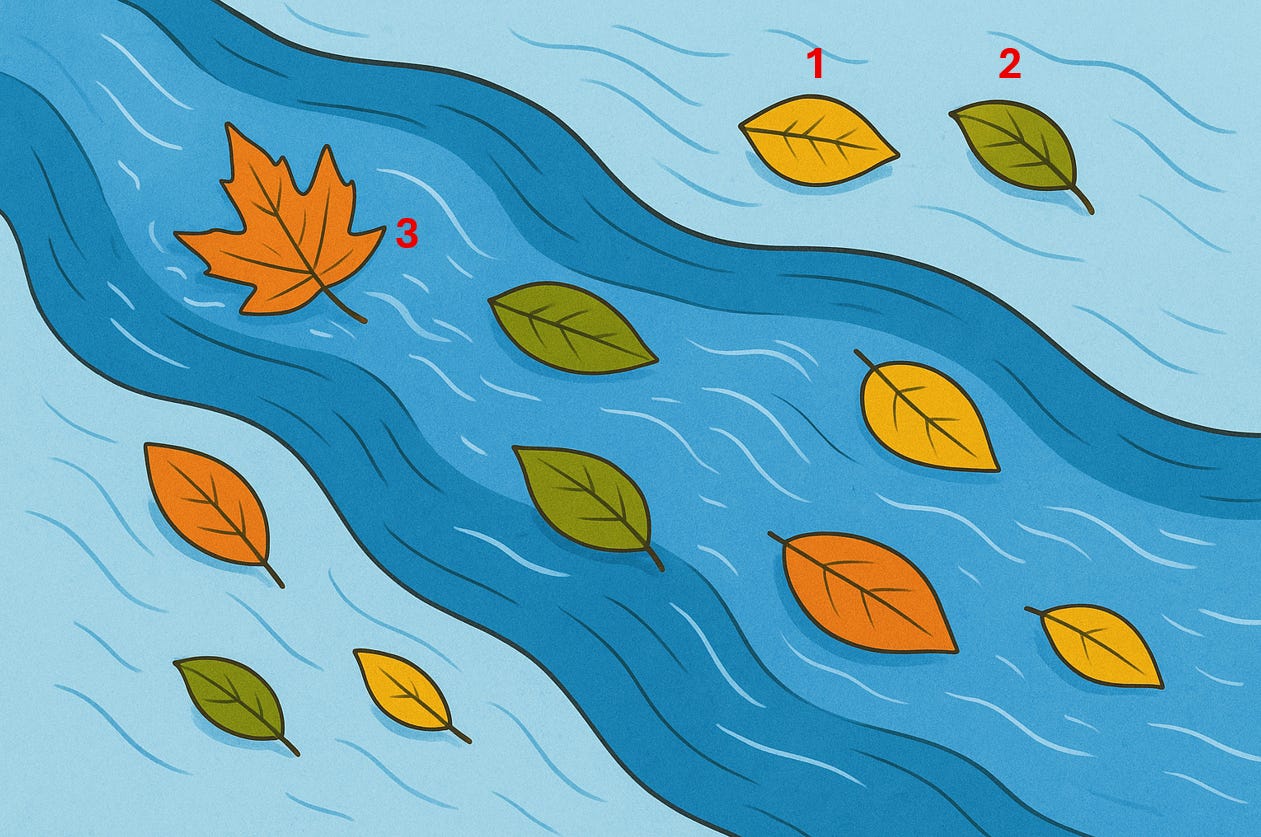
It is interesting, because people who have experienced a life of greater relative ease than the average person, will of course, wish to attribute this entirely to their own doing – like leaves 1 and 2 above. These people will no doubt be more likely to reject the idea that they weren’t the orchestrators of their success, that they were the all so impressive individuals who excelled to achieve what they have. That they have earned their stripes through merit. But our understanding of free will not existing says otherwise.
This means that nothing is anyone’s fault as such. We are all just witnessing the unfolding of biological processes – and our body is just one big interconnected biological process. There is ultimately no such thing as a good or a bad person beyond our social construct.
Every legend you have met, every funny person, every kind soul, every fuckwit..all of us are the result of physics-governed processes, and we are merely the executors of rules that help to further perpetuate a system that we call society, or more fundamentally, life.
Now as negative sounding as this may come across until now, I want to stress that I don’t actually see the notion of free will not existing as purely negative. Yes, I do prefer the idea of having at least some free will, but I want to contest why this doesn’t really matter too much anyway. More on this later.
For now, I want to make it clear that I see a huge amount of ways in which coming to terms with our lack of free will can positively impact your life. It can be the single most powerful tool you harness in changing how you react to the world and deal with past traumas. For me it was almost a spiritual awakening in terms of how I steer my mind away from obsessively worrying about past mishaps or mistakes, and instead focussing on wisdom and understanding that nature has a course. Try to be calm and don’t cause more damage to your peace by overthinking.
Give me visuals
So far I have used a lot of words, and I am aware that it is a dense topic. A picture is worth a thousand words, and a video in this case is worth a million. So I was keen to share with you a super important video that explains conceptually how I not only view the topic of free will, but how I think about the fundamental nature of reality.
This simple enough video truly dictates the core principle I use to think about everything.
So, without further ado, here it is …

It doesn’t look like much does it? Mesmerizing, yes, but still very abstract. So what’s the meaning of these weird colurful dots after all?
Well, this is a simulation that applies simple rules/equations to points in space (particles) to create beautiful and complex emergent entities like those you see here. Entities we could have had no way of predicting, and yet here they are before us. You can quite literally see how these little dots on a screen combine in weird and wonderful ways to construct new objects of greater complexity. I chose this particular simulation as it shows a couple of entities swimming around the space and eating smaller particles on the way. It reminds me of a cell arising from smaller proteins and molecules, moving about the body eating up bits of foreign matter.
I could delve deep into this fascinating area of complexity theory, but I will try and stay on topic and drive home the point I am actually trying to make here which is that we, and the world around us, are not so different to this simulation. I believe our univserse is based on simple enough rules, which when the simulation of our universe is run, it creates abundant and vast complexity – black holes, stars, planets, and life. Everything we know of at the end of the day is just a collection of particles. Just because we don’t ‘see’ the particles, it doesn’t mean that we’re different. Our brains are constantly creating illusions for us of the world around us, so we do not actually see the underlying nature of reality – which is just particles bouncing around everywhere on the edge of chaos and order.
PS, I want to quickly reference the person who built the amazing simulation I used here – Hunar Ahmad. I highly recommend visiting Hunar’s Github to create your own simulations here. I don’t know Hunar personally, but I am a big fan of his work. He has a PhD in neuroscience and creates brain inspired simulations which he shares on his YouTube channel.
Anyway, back to my point. Us humans, just like the particles being simulated above, are a much more sophisticated version of this dance of particles. If you’re having trouble understanding what I mean, I’ve included another image below to help steer you.
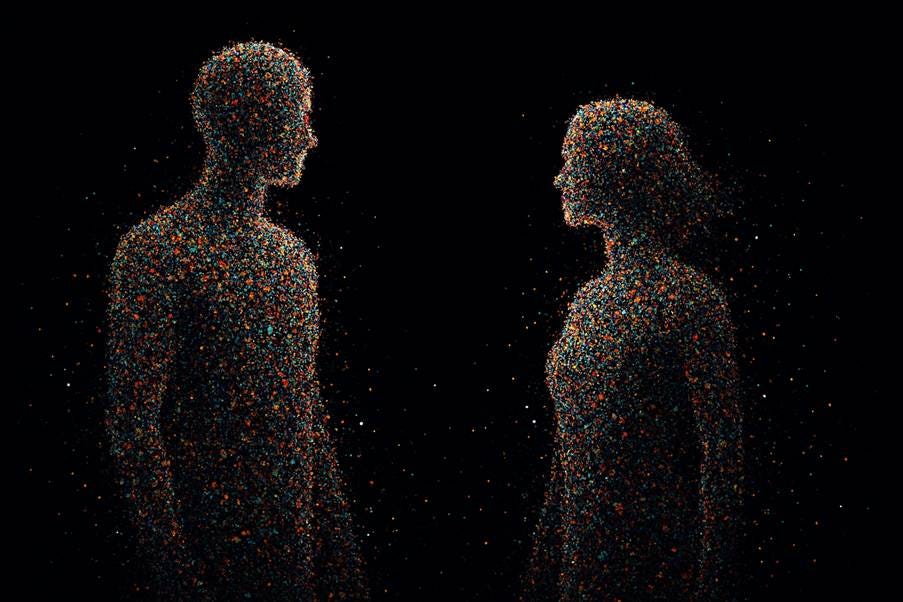
Obviously, this is a gross oversimplification of reality, but I am using it to convey my point, which I hope is starting to come across.
It highlights the concept of ‘emergence’ first hand – how simple rules can cause complex entities to arise seemingly out of nowhere. Now imagine this on a far far far grander scale, with a different set of rules that work in a far more boundless way – sounding familiar?
This is the ground principle i use to think about EVERYTHING! I believe our reality is not as dissimilar to these little ‘beings’ in the video as we think. We, like them, are a bag of particles that manage to find a point of balance between order and chaos – a point of homeostasis if you like.
So how is this relevant to the discussion of free will?
Just like the particles in the simulation, we too are bound by laws that are outside of our control. If you hit reset on the simulation you will get the same result – the partciles all behave in exactly the same way as the previous simulation we ran. It highlights in a nice visual way my central point that we are all just bags of particles moving according to laws that we have no say over.
Human nature
Now that you have a better idea of my main point, do you see how this has the potential to change your perception of life? For instance, that the main traits which constitute human nature are in themselves also emergent properties of the system.
It’s funny when you think about it.
All these human things traits we have.
Anger.
Jealousy.
Arrogance.
Ego.
Love.
We believe in them wholeheattedly. They are so real to us. So essential to being human. Perhaps they are necessary to create a system that works – something stable, something with morals, and judicial fariness.
To me, they are rules that have emerged. The particle simulation has become so advanced that individual entities that have formed have now built their own rules to help create stability and govern the system of which they are a part. Our emotions are at their core just very important rules which help balance the entire system.
But it begs the question – how do we account for criminals when they were always bound to commit crimes through no fault of their own?
In my opinion, they just got very unlucky. The deterministic nature of the universe meant their unique causal chains led them to do whatever they did. Maybe they were born impulsive, or with dopamine deprived brains, or they were mistreated as a child which changed the wiring of their brain. Every action anyone has ever taken follows a causal chain you can follow. If we knew all the variables at any given point in time, we could predict with 100% accuracy what a person would do next.
Our brain – the illusionist
Importantly, our brains don’t see reality. They simply can’t do that. So, instead, they create an illusion that helps us to navigate the external world in a way that makes sense to us and is conducive to us surviving. There is no such thing objectively as a colour, for instance. Our brains each create a different illusion based on the different frequencies of light hitting our retina. The crazy thing is we can’t even be sure that your red is the same as the red I am seeing, or any colour for that matter. This is because each of our brains is wired differently—our neurons connect in unique patterns—so our perceptions, or “qualia,” are simulations created by the brain and differ from person to person. Let that sink in.
Be aware that we’re constantly being tricked. Don’t trust your brain to give you an accurate depiction of ground truth.
Why it doesn’t matter that we have no free will anyway
I like to think about consciousness as existing at the end of a chain – the result of lots and lots of neural processing. The conscious experience is perhaps the most beautiful thing to come out of the universe, and is still something we can’t accurately explain.
However, what we do know is that our brains are sophisticated prediction machines. They predict absolutely everything, from the external to internal world. So, it follows that our brain will learn to predict our consciousness itself. It will start to find patterns associated with our conscious state, and will help to make decisions in line with our self of self. So perhaps it doesn’t really matter if we are not ultimately choosing if our choices are automatically made by our brains in line with our central sense of self.
How you can use this new knowledge to live a better life
1. Don’t regret past actions.
Yes, think about them, grieve about them, but absolutely do not overthink past decisions with a heart full of regret. Whatever happened was always bound to happen – like a leaf floating down a stream. But unlike a leaf, you have emption and thus must deal with the uncomfortable awareness and sensation that you were in control of your passage through space and time. Embrace the path you are on, no matter how hard it may feel, and above all, be kind to yourself and others along the way.
2. Subsconscious is everything.
Your experience of consciousness is just the final emergent layer that arrives from the neural processing before it. Trust your gut – there is more in it than you give credit for.
3. Be way kinder and more empathetic than you are currently being
Try to actually understand why others behave rather than immediately judging them. Some people, through no fault of their own, are bound to a life of greater suffering than others. How unfair is that? They have to experience the reality of a more brutal existence all while feeling like they were in control or even responsible for their struggles. It is analgous to one of the entities in the particle simulation animation which bounces around more than the others and eventually collapses. Next time you see that homeless man, don’t think it is their fault they are there – it actually ultimately isn’t! They were destined to end up without a home, just as you were destined to receive the opportunities you did. Their situation is no more their fault than your successes are yours.
4. Don’t compare yourself as much as you do.
Meritocracy is ultimately a hoax. If we were all bound to do whatever we’ve done, then some people were born with a lucky hand and others with an unlucky hand. The universe doesn’t care as such – it is likely just a big simulation, and as part of this, some things are fated to end well and some badly. Trust the course and don’t get court up comparing yourself to others. We are all on different paths.
5. Know that your emotions are playing out and that you don’t control them.
You didn’t cause any emotions you are dealing with, but you are experiencing them. By being aware that all they are is a process playing out in your brain and that you are not the controller of them, you can create a more compassionate environment for yourself with less shame .
Rebuttals to mass acceptance of free will not existing
Despite all my conviction about the awakening I have had around my lack of free will, there is still one thought I have had to the contrary that plays on my mind. That is whether the question of whether mass adoption of the belief in no free will is really a beneficial thing for society? Or does it lend itself to nihilism and existential angst – as in, does it encourage people down a path of wondering what is the point of anything if it is only ever going to unfold in one way. This is not an uncommon reaction to those who have come to understand that their subjective experience of choice isn’t really determined by them.
What are the ramifications for society if most people actually believed there was no free will? Would we be a better, calmer, more empathetic society? Or do we risk de-humanizing ourselves and stripping out meaning and the very things that make us human?
Conclusion
I hope you can start to see the world from a different angle now, or at the very least, have been opened to a new way of coping in the ever complex and confusing world that is the human experience.
If you found this interesting and were keen to learn more about this topic, I’d highly recommend Robert Sapolsky’s book ‘Determined’ which delves right into the nature of this question and its implications on morality. If you want to try and grasp the nature of the question better, I’d also highly recommend any of Sam Harris’ podcasts on the topic, or Sabine Hossenfelder’s Youtube videos on the subject.